


SonNext Facial and Body treatment device is build around High Intensity Non-Thermal Ultrasound effect. In contrast to HIFU (High Intensity Focused Ultrasound) SonNext device utilizes Non-Focused and Non-Thermal energy of the ultrasound. Usage of mechanical only energy gives a huge advantage over the thermal energy which leads to inevitable tissue destruction. As base technology suggests, Non–Thermal energy (mechanical energy), does not significantly raise the temperature of the treated tissue, thought, any excessive concentration of the mechanical energy would eventually lead to a conversion process of mechanical to thermal energy. SonNext patented wave distribution technology ensures an even energy coverage over the whole treated area as well it eliminates the risk of the tissue overheating even at the highest power level. Usage of High Power (up to 3W/cm2) combined with an advanced wave distribution system and Media distribution system allows SonNext device to benefit from all major Non-Thermal Ultrasound Effects as well their combination during the treatment such as: Sonophoresis
Abstract:
Therapeutic ultrasound effects on living tissue might be grouped by two major categories: Thermal and Non-thermal. Non-focused ultrasound is capable of producing thermal therapeutic effects. Recent in vivo studies show that dissipated ultrasound beam is could increase the tissue temperature at a rate of 0.16°C/min (1 W/cm2, 1 MHz), up to 42°C. 3-MHz frequency increased tissue temperature at a faster rate than the 1-MHz frequency (Ashton, Chan). However, as the temperature increases, the normal blood flow to the area dissipates the heat, thus limiting further temperature rise. Focused ultrasound or high intensity focused ultrasound – HIFU is capable of reaching 70°C and beyond, where tissue destruction is inevitable. SonNext technology is solely based on Non-thermal effect of the therapeutic ultrasound, taking it several steps further to prevent any heat related issues.
Acoustic Streaming
Therapeutic ultrasound produces a combination of an acoustic streaming and cavitation effects that are difficult to isolate. Acoustic streaming is defined as the physical forces of the sound waves, generated by the areas of the high and low pressure, that provides a driving force capable of displacing ions and small molecules. At the cellular level, organelles and molecules of different molecular weight exist. While many of these structures are stationary, many are free floating and may be driven to move around more stationary structures. This mechanical pressure applied by the wave produces unidirectional movement of fluid along and around cell membranes.
Cavitation
Cavitation is defined as the physical forces of the sound waves on microenvironmental gases within fluid. As the sound waves propagate through the medium, the characteristic compression and rarefaction causes microscopic gas bubbles in the tissue fluid to contract and expand. It is generally thought that the rapid changes in pressure (caused by the leading and lagging edges of the sound wave), both in and around the cell, may cause damage to the cell. Substantial injury to the cell can occur when microscopic gas bubbles expand and then collapse rapidly, causing a “micro-explosion.” Although true micro-explosions, referred to as unstable cavitation, are not thought to commonly occur at therapeutic levels of ultrasound. Early studies investigating the gross effects of acoustic streaming and cavitation on cells showed growth retardation of cells in vitro, increases in protein synthesis, and membrane alterations. Combined, these results may suggest that ultrasound first “injures” the cell, resulting in growth retardation, and then initiates a cellular recovery response characterized by an increase in protein production.
Shear Stress
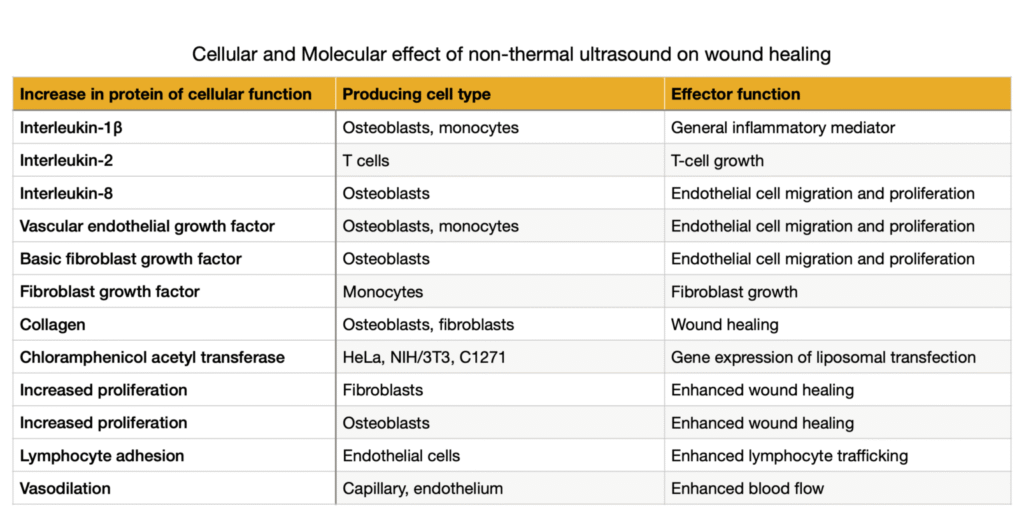
Shear stress of the ultrasound alters cellular membrane properties (cellular adhesion, membrane permeability, calcium flux, and proliferation), possibly activating signal-transduction pathways that lead to gene regulation Importantly, exposure to ultrasound caused an increase in intracellular calcium in fibroblasts, suggesting that the mechanical effects disrupt the normal function of the membrane, permitting leaking of calcium into the cell. After ultrasound exposure, the cells rapidly expelled the calcium and returned to a homeostatic state. Mortimer and Dyson eliminated the effects of transient cavitation and gross heating as possible mechanisms for the resultant increases in intracellular calcium. Cells employ calcium as a cofactor in regulating the activity of enzymes, many of which are associated with signal-transduction pathways. Activation of calcium-sensitive signal-transduction pathways (protein kinase C and cyclic AMP) commonly results in gene activation. The resultant protein production could modulate intracellular functions and the activity of surrounding cells. A number of the experiments reviewed in the Table demonstrated increases in specific proteins after exposure of cells to therapeutic levels of ultrasound. Combined, these findings suggest that therapeutic ultrasound can modulate signal-transduction pathways that lead to gene regulation or the modulation of RNA translation to a protein product, or both. Cumulatively, the data may suggest that the mechanical energy within the ultrasound wave and the shearing force of the wave combine to produce mechanical properties that perturbate the cellular membrane and the molecular structures within the cell.
Resonance hypothesis
As noted above, the combination of effects would further enhance the treatment results. As the brightest example we could observe the Sonophoresis combined with Skin Care Media distribution further combined with Acoustic Streaming. Where the first (Sonophoresis) provides the passages through the upper epidermis, Media Distribution System applies a layer of media and finally the Acoustic Streaming pushes the media transdermally. Effect of the Shear Stress applied to the dense static tissue creates wide passages and opens the supply chain where it was long disrupted, here again, Acoustic Streaming enhances the drainage and drug delivery.
Pre-defined treatments duration varies between 20 to 40 minutes, and in addition to fully automated control the system allows manual intervention in order to personalize the treatment. Depending on the treatment type procedure may contain different stages and employ various media types. Custom treatment protocol can be implemented on request.